
Plus, useful animal sayings in Latin!
Is it a mini-podcast?
I decided to record a little of what I think about Latinitas and when it’s useful to think about it, announce that I’m writing a new novella, and discuss resources I use when I write:
Topics in this discussion:
- What is Latinitas to me in the 21st century.
- When is it useful to think about Latinitas or try to use “correct Latin.”
- How to approach vocabulary when writing resources for students.
- Avoiding assigning modern English meanings to Latin roots [of English words].
- Prioritizing high frequency words from historical literature in didactic materials.
- I’m writing a new intermediate novella about Erictho!
- Resources I use when writing Latin:
- PHI Latin texts (a searchable corpus of Classical Latin
- Morcus.net or the dictionaries on Latinitium
- Wagner’s thesaurus
- Forcellini’s Latin-Latin dictionary
- Thesaurus Linguae Latinae
- Walter Ripman’s “A Handbook of the Latin Language” (with a classified vocabulary; just added to Google books and Archive)
Useful animal sayings in Latin
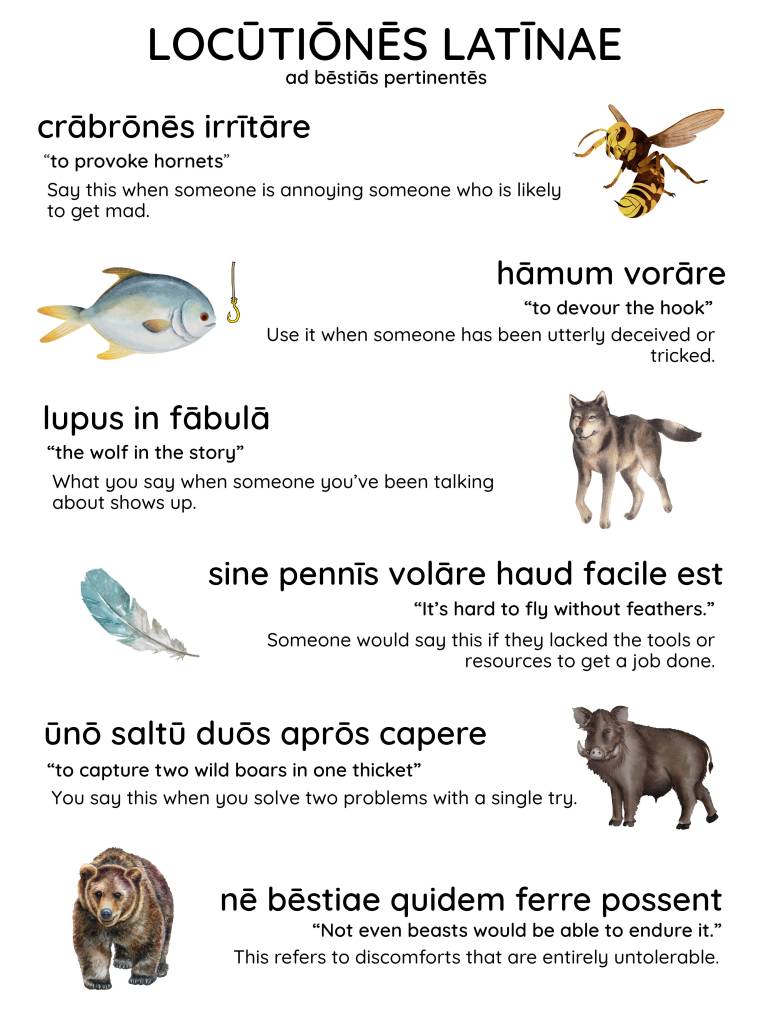
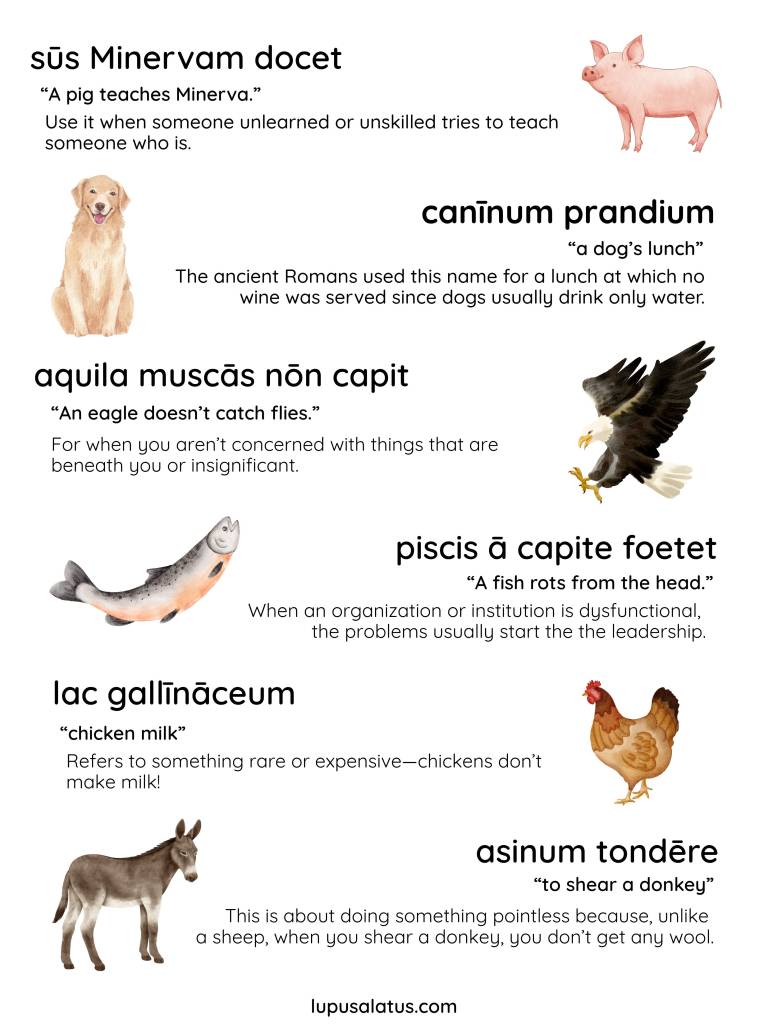
If you follow us on social media (IG, FB), you may have noticed we like to learn and share proverbs or sayings in Latin. And while we generally like paremiology, our favorite proverbs involve animals. Recently, we created a poster with some of our favorite animal proverbs that mostly originate in Classical Latin:
We also have many other posters that are helpful for the Latin classroom:
Sources of the sayings on the posters above:
- Ne bestiae quidem ferre possent. Cicero, In Verrem.
- Sus Minervam. Also a very common proverb in the ancient word. Cicero in his Epistulae.
- Caninum prandium. Aulus Gellius discusses it in his Noctes Atticae.
- Aquila muscas non capit. I think this might be originally Greek. Erasmus translates it here.
- Piscis a capite foetet. Eramus is just like, yeah this is really common, and gives it in Latin and Greek. I’ve heard this before in English too. I don’t know what the original ancient source is.
- Lac gallinaceum. Probably originally in Greek. It’s in Aristophanes’s Wasps. Pliny makes mention of it in his Naturalis Historia.
- Asinum tondere. Erasmus gives its original source as Aristophanes’s Frogs, so it was Greek.
- Crabrones irritare. Plautus, Amphitruo.
- Hamum vorare, Plautus, Curculio.
- Lupus in fabula. This is in both Terence and Cicero. It appears to have been a very common proverb in Latin and ancient Greek.
- Sine pennis volare haud facile est. Plautus, Poenulus. Erasmus says this proverb was common in Europe even during his lifetime.
- Uno saltu duos apros capere. Plautus, Casina.
Summer reading!

Are you looking for some not-so-light summer reading? Would you like ensure your personal space on the beach with chthonic curses? To terrifying your fellow beach-goers by spicing up your morning walks with a side of necromancy? This summer might be the time to try our tiered Latin reader of the Roman poet Lucan that features the Greek witch Erictho.
Erictho, Tartarorum Terror features:
- Over 12,000 words of Latin
- A Latin-Latin glossary and notes on each page
- Lucan’s verses explained and retold in two different levels of Latin
- Tips for reading hexameter
- A Latin introduction to prosody and metrics
 Lupus Alatus
Leave a comment